Elecbrakes told customers on November 23, 2026, to fix a Bluetooth vulnerability in its trailer brake controllers. The flaw let any phone or laptop in range apply a trailer's brakes at any force. It took four bytes and no pairing, PIN or authentication of any kind.
The Australian manufacturer published a customer advisory for EB2 and VM1 owners. It tells them to install firmware released on July 6 before their next trip. The original ELBC model cannot receive that update. Elecbrakes says it is unaware of any exploitation, property damage or injuries linked to the bug.
Patrick Forck and Jeremy McCarthy of Element Digital published their research on November 19. CISA released advisory ICSA-26-323-02 the same day, covering three CVEs. The main bug, CVE-2026-96805, scores 9.6 out of 10 on CVSS 3.1 and falls under CWE-306 (missing authentication for a critical function).
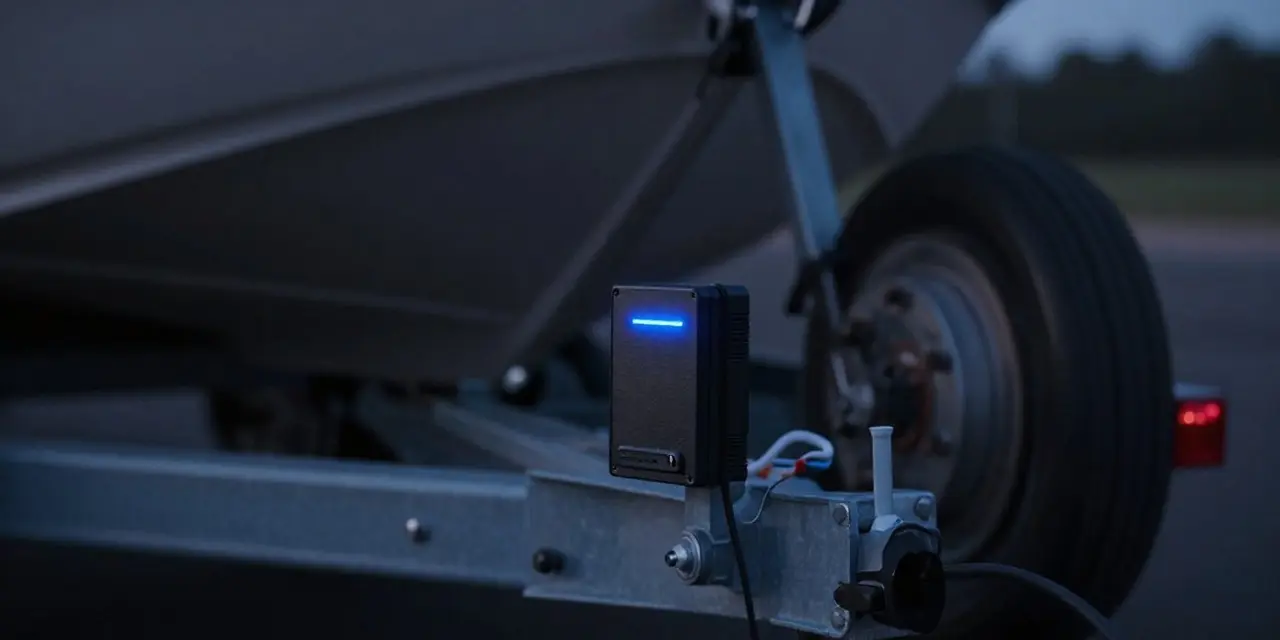
The EB2 mounts on the trailer itself, while the VM1 is fitted in the tow vehicle. Drivers operate both over Bluetooth Low Energy (BLE) from a phone app or a small in-car remote. According to CISA, the products are deployed in Australia and New Zealand. Element Digital puts the attack range at roughly 10 to 100 metres.
Forck found the problem by accident on a highway. His Elecbrakes remote connected, with no pairing or prompt, to controllers on trailers he had never seen. The trailers he met most often are run by Sensys Gatso for the Tasmanian Government.
The two researchers used the Claude AI model to reverse engineer the decompiled Android app. The analysis mapped 47 BLE characteristics across four services, with commands sent as plain unencrypted byte arrays. The firmware demanded pairing for its bonding and update functions. Brake control, a characteristic named User Commands, accepted writes from anyone.
Writing 14 00 00 00 to User Commands energised the brakes. The second byte sets the force, and 14 FF 00 00 produced far stronger deceleration in a test on a private road. Fuzzing showed that practically any non-zero first byte triggers braking in some mode. The controller even reports each state change back, so an attacker gets confirmation that the command landed.
The electromagnetic hum at the brake drums was immediate and, frankly, a little sickening.
— Patrick Forck and Jeremy McCarthy, researchers, Element Digital
Element Digital built its research tool as a Web Bluetooth page in Chrome. No specialised radio hardware was needed, just a laptop with Bluetooth. The live findings came within four hours of testing.
The Elecbrakes design has one safeguard. When the attacker's connection drops, the brakes release after two to five seconds. That limits a drive-by. A stationary attacker can simply wait near a boat trailer on a ramp or a caravan parked on a hill.
A loaded boat trailer commonly weighs 1.5 to 4 tonnes, according to Element Digital.
Your trailer's brakes slamming to maximum while your tow vehicle keeps going is the exact recipe for a jackknife - one of the more reliably fatal things a vehicle combination can do.
— Patrick Forck and Jeremy McCarthy, researchers, Element Digital
CISA tracks the replay weakness as CVE-2026-125273, also rated 9.6. Commands carry no sequence numbers, nonces or session tokens. The controller keeps the last command written to it, and anyone in range can read it back without pairing. Elecbrakes asked CISA to lower the score to 8.2 but later agreed it should stand.
CVE-2026-124281 (CVSS 6.1) covers the firmware update channel. It relied on Just Works pairing, a Bluetooth mode with no PIN or passkey, and on CRC32 checksums. The decryption key for firmware images ships inside every copy of the app, though the researchers chose not to flash modified firmware.
CISA warns attackers could alter firmware, disable brake lights or switch off other critical safety features.
Elecbrakes shipped new firmware on July 6, seven weeks after the May 18 report. Brake control now sits behind an encrypted, bonded connection. First-time pairing requires a physical brake-pedal sequence that cannot be injected over Bluetooth. The firmware image is still unsigned, and Elecbrakes says its next app release will add signing.
The new pairing scheme breaks older V2 remotes. Elecbrakes offers a free V3 replacement, and customers can run the controller from the app while they wait.
Disclosure took far longer than the repair. Element Digital opened CISA case VU#425218 on July 3, and from mid-August Elecbrakes went 53 days without a reply. The company also did not respond to the researchers' August request for an interim plain-English advisory. The November 23 notice arrived four days after the public write-up.
The ELBC 2000 surfaced late in that process. Forck spotted one on a local trailer in September, and Elecbrakes confirmed at the end of October that it shares the flaw. CISA lists no remedy for the model and reports that the vendor is still working out how to address it.
Elecbrakes should have identified it at the start and included it in their remediation plan.
— Patrick Forck, researcher, Element Digital
The EB2 and VM1 patch does not install itself. By late October, about 60% of daily active users ran the fixed firmware, according to company figures cited by Element Digital. Elecbrakes co-founder Craig de Leon has since put the share at 60 to 70% of controllers that connect each day.
A Bluetooth bug that brakes a trailer took four hours to find. By late October, three and a half months after the fix shipped, about four in 10 active app users still lacked it. When a safety patch waits for the driver to open an app, the rollout moves at the driver's pace.
— AnonHaven Editorial Team
EB2 and VM1 owners should first update the Elecbrakes app. With the trailer hitched so the controller has power, they should connect and follow the on-screen firmware prompt. Afterwards, check for EB2 version 3.0.4.4.3 or VM1 version 1.3.4.2.1 or later. Elecbrakes customer support answers on 1300 516 248.
V2 remote users should read the exchange instructions before updating. A free V3 replacement is available on registration. Drivers who rely on the remote while travelling should call support first. ELBC owners have no patch, and Elecbrakes advises them to stay actively connected to a smartphone or remote whenever the controller is in use.
Have a story? Become a contributor.
We work with independent researchers and cybersecurity professionals. Send us a tip or submit your article for editorial review.