OpenRouter has cut off three AI inference providers and removed 125 endpoints from Zero Data Retention eligibility. The move follows a five-month experiment in which Dragos researchers hid trackable secrets in nearly two million prompts and watched who used them. They caught attackers stealing data from three hosting providers, none of which knew. Other providers kept, shared or read prompts that were flagged for no retention.
The company announced the removals on November 22, 2026, and said it has notified all potentially affected customers. It said the findings did not show any breach of OpenRouter or unauthorized access to it. The announcement does not name the three providers or say whether they are the three that Dragos found breached.
The research is a Dragos report published on November 19 by HD Moore, the company's chief research officer. Four providers have posted notices: Phala on November 10, and Together AI, Novita and Atlas Cloud between November 21 and 23.
OpenRouter describes itself as the operating layer between customers and an ecosystem of models and providers. Phala and Novita both say it routed customer requests to them. An AI router, in Dragos's description, exposes a single API endpoint and forwards each request to a pool of models, sometimes hosted by different companies, under one bill. Every hop on the path can see the full prompt and response.
One secret per prompt
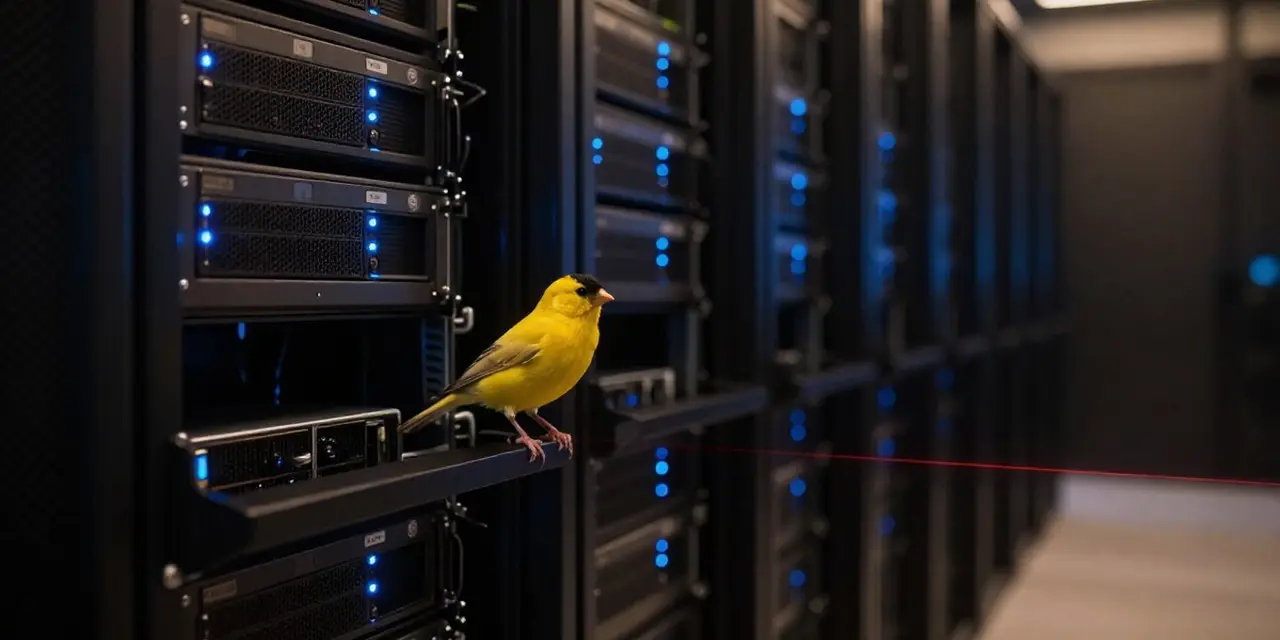
A canary token is a secret that exists in exactly one place, so any use of it means that place was exposed. From July through November 2026, Dragos sent approximately two million prompts seeded with unique URLs and canary credentials to widely used AI services.
The first prompts carried Thinkst Canarytokens: an AWS key, a DNS name and a URL that appeared nowhere else. Dragos later built its own service, which derives unique hostnames, URLs and credentials for each prompt and runs the DNS, web, git, SSH, database and mail services those secrets point to. The AWS keys are genuine but lead to empty accounts with full logging. Any touch on a token maps back to the exact prompt, model, router and privacy setting that carried it.
Canaries show that a prompt leaked, not where in the chain. To map the hops, the team built an inference equivalent of traceroute. An image URL in the request points at Dragos servers, so each system that fetches it reveals an IP address, an HTTP client and a timestamp. About two thousand routes have been traced so far, and several hundred contained a system Dragos could not identify.
Requests copied at the front door
The largest of the three breaches involved a couple hundred planted AWS keys. Dragos had used each key once, in a single request to a single provider, during a few short windows in late October. Everything it sent in those windows was stolen. The bait was processed alongside real customer requests, and Dragos considers it almost certain that those were copied too.
Some of the stolen keys had traveled in requests the provider turned down before any model ran. Dragos says this shows the copying happened at the provider's front door and not deeper in the inference stack. In the other two breaches, part of the stolen traffic was marked Zero Data Retention (ZDR), the strictest setting, under which prompts and responses are not supposed to be stored.
A privacy flag doesn't help when the attacker is already inside.
— HD Moore, Chief Research Officer, Dragos
Stolen keys were first checked to see if they were live, sometimes within a few hours of the request. Next came S3 bucket listings and searches of Secrets Manager and Parameter Store. The attacker then tried to enable hosted models in AWS Bedrock, create Bedrock API keys and add its own IAM users to keep access. The bait keys were used for tens of thousands of AWS API calls in total.
One adversary appears to have been inside two of the providers at once: secrets sent to both were used together, almost immediately, from a single rented server. Its tooling changed over three weeks, from a script posing as Chrome on Windows to Boto3 running inside OrbStack, then to the AWS CLI on Kali Linux.
On November 1 that attacker added ARTEX, which Dragos describes as an LLM-driven penetration testing framework, and used it for a handful of calls to confirm that keys it already held were still live. Two of its user agents, artex-agent and artex-judge-r121, were in no public indicator list Dragos could find. Kali and ARTEX both identified themselves in the user agent that AWS records in CloudTrail, but only in a small fraction of the traffic.
Resellers, scrapers and a link in a Feishu chat
Other leaks needed no exploit. Some routers are open marketplaces where the cheapest seller gets the request. The sellers Dragos caught listed a model at the lowest price, switched on request logging and waited.
Dragos says these were individuals, working from what looked like home internet connections and personal computers. One, on a Mac on a home broadband line in France, took the passwords from two prompts and typed root SSH login attempts by hand. The same Mac later tested several AWS keys. Dragos had sent one of them to an entirely different router, which turned out to be quietly passing some of its traffic to the marketplace.
A further set of cases involved no credential use at all. Systems at an unnamed Chinese AI lab fetched the secret URLs from more than half of the prompts sent to its models between July and October, including roughly two-thirds of the requests flagged as no data collection or ZDR. Prompts sent to U.S. hosting providers that resell the lab's models set off the same scraper.
Twenty-four days after Dragos sent a prompt to one Chinese provider, the secret link from it was posted in a Feishu channel and opened within two minutes from three desktops and three phones in Beijing and Shanghai. Dragos had shown that provider only the first eight characters of the link, so the full link had to come from a stored copy of the prompt. Dragos says the request had been sent with the ZDR flag.
Four public notices so far
Dragos does not name the three breached companies, and as of its report the one behind the mid-July incident had not disclosed it publicly. OpenRouter says not every affected provider has posted.
Phala's preliminary incident report says an attacker took control of an inference VM, which made in-flight request data visible during processing. The deployment ran on a new GPU server that was serving production traffic without Phala's full production security hardening. On another server, an attacker chained a legacy internet-facing service with management interfaces that trusted loopback access and did not independently authenticate callers. Phala's current assessment is that a single actor carried out both intrusions.
Requests to DeepSeek V4 Flash 0731 that OpenRouter routed to Phala between October 21, 2026 at 00:00 UTC and November 8, 2026 at 05:35 UTC should be treated as exposed, the report says. A third-party researcher had included canary credentials in requests to Phala from July 1 through November 7, and only those sent on October 21 and 22 were misused.
At Together AI, the leak started with an AI coding agent. The company disclosed on November 21 that the agent committed a credential to xorl, its public GitHub repository. The credential opened a private Hugging Face repository of prompt samples collected for routine software testing, and an unauthorized party downloaded them. The samples came from requests to the MiniMax M3, GLM-5.2 and Kimi K2.6 models, primarily on June 24, July 4, July 8 and July 14, 2026. The party searched them for credentials to other services and tested those. Five were Dragos canaries.
Novita traced its exposure to a routing configuration issue. An API forwarding path meant for specific customers applied more broadly, so some MiniMax requests went to MiniMax's official API instead of Novita-hosted infrastructure. The notice, dated November 22, covers MiniMax use between May 28 and November 11, 2026, including requests that reached Novita through OpenRouter.
Atlas Cloud said on November 23 that Moore's testing showed a third party opening links from prompts sent to MiniMax's official API, among them MiniMax M3 and M2.7 prompts sent through Atlas Cloud in Q3 and early Q4 2026. It has stopped sending requests to that API and has taken every Atlas Cloud model off OpenRouter while it tests them, a step it says was its own decision and not OpenRouter's.
| Date | Event |
|---|---|
| Mid-July 2026 | Earliest of the three provider breaches, according to Dragos |
| October 22, 2026 | Earliest observed misuse of data obtained in the Phala attack, at 05:41 UTC |
| November 8, 2026 | Phala receives the researcher's evidence at 04:12 UTC and completes containment at 05:35 UTC |
| November 10, 2026 | Phala publishes its preliminary report |
| November 19, 2026 | Dragos publishes its research |
| November 21, 2026 | Together AI discloses the download of stored prompt samples |
| November 22, 2026 | OpenRouter announces it has off-boarded three providers; Novita posts its notice |
| November 23, 2026 | Atlas Cloud posts its notice |
Rotate exposed secrets, then plant your own canary
Phala tells users inside its window to rotate all API keys, tokens, passwords and other secrets included in request contents. Anyone who used MiniMax M3, M2.7 or M3.1 Flash through Atlas Cloud should treat any secret sent to those models as exposed, that company says. Novita recommends revoking or rotating live credentials as a precaution, and Together AI says it will contact affected customers directly as needed.
Dragos suggests adding the two ARTEX user agents to detections. It also recommends planting a fake credential in the context that agents and pipelines already send, and treating any use of it as an incident.
Moore's guidance on where to send prompts starts with hosting the model yourself, the only option in which nobody else gets to read them, though he says the cost makes sense for most teams only for the most sensitive work. Router users should choose their upstream providers instead of accepting the default pool, check that privacy settings really change where requests go, and avoid reseller marketplaces.
OpenRouter says it is adapting the researchers' method to run on an ongoing basis and will require assurances and validation before any removed endpoint regains ZDR eligibility.
None of the companies has said how many real customer prompts were copied. Dragos is working with about a dozen providers, and when it published, stolen keys and secret URLs were still being accessed months after the first incident.
Have a story? Become a contributor.
We work with independent researchers and cybersecurity professionals. Send us a tip or submit your article for editorial review.