

This isn't forum speculation-it's reality. AI has lowered the barrier to entry for macOS malware development to near zero. What once required expertise now takes ChatGPT and a basic prompt. SimpleStealth's code screams AI-generated: excessive comments, repetitive logic, a mix of English and Portuguese. Worst of all, no antivirus detected it at the time of discovery.
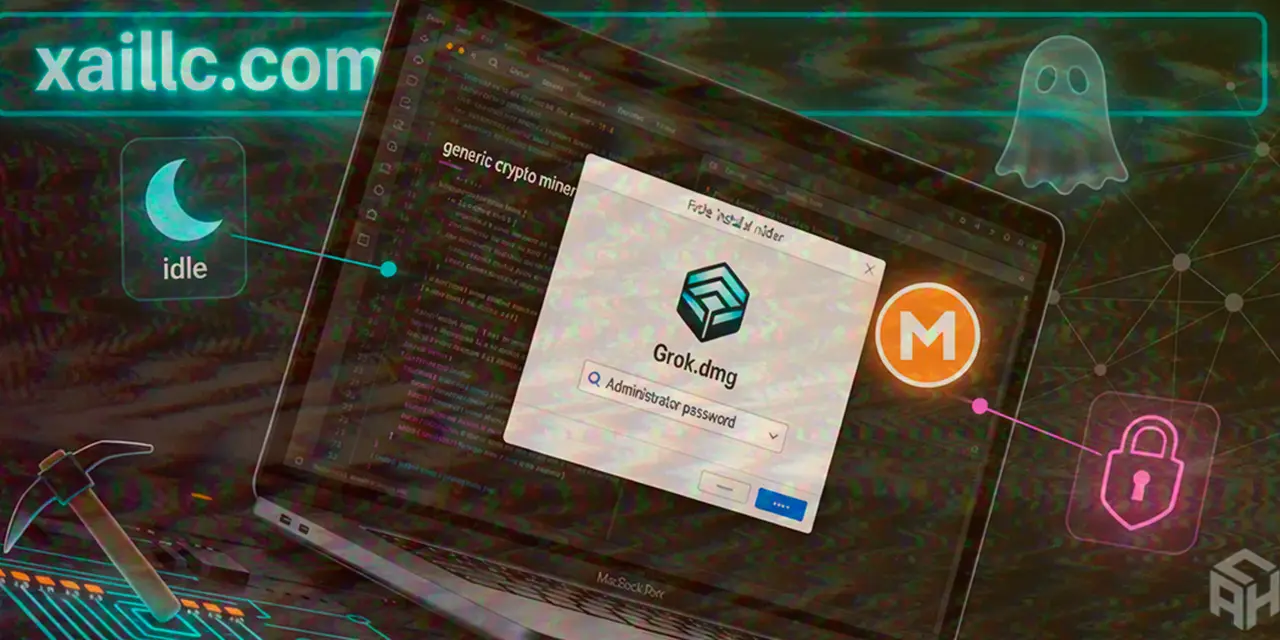
On January 9, 2026, Mosyle researchers published an analysis of what they call the first macOS malware campaign showing clear signs of generative AI in its code. This wasn't a laboratory proof of concept-it was actual malware spreading in the wild. The campaign, dubbed SimpleStealth, used a fake website impersonating Grok, xAI's popular AI application. Attackers registered the lookalike domain xaillc.com and distributed Grok.dmg as if it were the official macOS installer.
Critical detail: at the time of discovery, neither the disk image nor its payload were detected by major antivirus engines. Even macOS's built-in XProtect failed to catch it. This signals a major problem: signature-based detection struggles when code is unique and slightly different with each generation.
How SimpleStealth works
The entire delivery chain relies on social engineering. A user searches for Grok for macOS, lands on xaillc.com, sees a standard landing page with a "Download for macOS" button, and downloads Grok.dmg. What follows looks like setup but functions as security bypass.
After launching the DMG, victims see an application that behaves convincingly: the interface renders properly, AI responses appear-everything seems legitimate. Against this backdrop, the app requests an administrator password, supposedly to complete installation. In reality, the password removes macOS's quarantine attribute and enables the main payload to run without typical Gatekeeper warnings.
Once it has privileges, SimpleStealth deploys a Monero miner. The choice of XMR makes sense: it's a privacy coin whose transactions are extremely difficult to trace. Mosyle's report includes the Monero wallet address receiving mined funds: 4AcczC58XW7BvJoDq8NCG1esaMJMWjA1S2eAcg1moJvmPWhU1PQ6ZYWbPk3iMsZSqigqVNQ3cWR8MQ43xwfV2gwFA6GofS3
Next comes stealth mode. The miner doesn't run constantly. It only starts when the device has been idle for more than one minute and instantly stops when the mouse moves or keyboard is used. In the system, the process attempts to blend in by masquerading as kernel_task and launchd. This is smart camouflage: kernel_task normally consumes 10-30% CPU when macOS manages thermal throttling, so additional load doesn't always raise suspicion. Victims can go weeks without noticing the mining, attributing laptop heat to normal wear.
Mosyle specifically describes AI-generation markers in the code: excessively detailed comments that read more like student explanations, repetitive logic blocks and identical functions in different locations, a mix of English and Portuguese in comments and variable names, and overly verbose print statements that malware developers typically don't leave behind.
Why this matters more than just another miner
First, a warning has come true. Back in January 2025, Moonlock Lab researchers reported that underground forums were actively discussing using LLMs to write macOS malware. Their 2025 report mentioned signs of AI-assisted approaches in the MacSync/mentalpositive family, including comprehensive comments in the style of AI-generated examples. SimpleStealth appears to be the first confirmed case where the model didn't just assist but actually generated most of the malicious code.
Second, the economics of attacks are changing. Previously, macOS malware required knowledge of Swift, Objective-C, or at least Python, understanding of the macOS security model, and practical experience bypassing protections. Now a prompt like "write a script to mine Monero on macOS, launch only when idle, disguise as kernel_task" is enough. AI can produce a working foundation in seconds. This is the democratization of malware.
Third, traditional signatures are breaking down. Each new query to the model produces slightly different code and different hashes. If defenses rely on SHA-256 matches and known patterns, they start losing. Behavioral analytics and EDR are needed here, or this story will repeat in different wrappers.
For context on motivation, Mosyle provides the economics: a Monero miner on a MacBook Pro can generate $0.50-2.00 per day. A botnet of 10,000 Macs yields $5,000-20,000 daily. For victims, this typically means 20-40% higher electricity consumption and accelerated CPU wear, plus noticeable performance degradation and excess heat that can be attributed to device age for months.
The indicators of compromise published by Mosyle are:
Domain: xaillc.com
SHA-256:
553ee94cf9a0acbe806580baaeaf9dea3be18365aa03775d1e263484a03f7b3e (Grok.dmg)e379ee007fc77296c9ad75769fd01ca77b1a5026b82400dbe7bfc8469b42d9c5 (Grok wrapper)2adac881218faa21638b9d5ccc05e41c0c8f2635149c90a0e7c5650a4242260b (grok_main.py)688ad7cc98cf6e4896b3e8f21794e33ee3e2077c4185bb86fcd48b63ec39771e (idle_monitor.py)7813a8865cf09d34408d2d8c58452dbf4f550476c6051d3e85d516e507510aa0 (working_stealth_miner.py)
For corporate networks, Mosyle specifically notes the network footprint of mining and typical pool ports: 3333, 4444, 5555. If an organization relies solely on XProtect and default settings, this class of attack will pass through too easily.
SimpleStealth isn't the most sophisticated malware in the world. But it matters as a time marker. Before AI, creating macOS malware meant weeks and expertise. After AI, it often means five minutes and a prompt. If the first confirmed case turned out to be a mundane miner, that's no reason to relax. It's simply the cheapest way to verify that the new model works.
Have a story? Become a contributor.
We work with independent researchers and cybersecurity professionals. Send us a tip or submit your article for editorial review.